


Apr 29,2011
China's new plastic pipe industry boasts the world's fastest growth rate.
Since 2000, China's plastic pipe production has ranked second in the world, reaching a total output of 4.593 million tons in 2008. In recent decades, China's plastic pipe industry has developed rapidly, with production increasing from 200,000 tons in 1990 to nearly 800,000 tons in 2000, maintaining an annual growth rate of around 15%.
Apr 29,2011
CPVC is a chlorinated product of PVC, i.e., a chlorinated modification of PVC. PVC resin is the main raw material for producing CPVC resin; it must be loose and not compact.
Apr 29,2011
About PP, PP-H, PP-R, PP-C, and PP-B
Previously, a type of pipe called PP-C appeared on the domestic market. Many people were unclear about the differences between PP-C, PP-R, and PP-B, leading to misunderstandings and confusion. In fact, PP-C is a general term for random copolymer polypropylene, and PP-R and PP-B, which have quite different properties, both belong to the PP-C category. Therefore, there is no PP-C pipe in the standard. International standards for polypropylene hot and cold water pipes include PP-R, PP-B, and PP-H.
Apr 29,2011
Pipeline construction procedure
I. Scope This procedure applies to the excavation and backfilling of pipelines and trenches at the site, as well as the on-site loading, unloading, prefabrication, installation, inspection, pressure testing, cleaning, corrosion protection, and insulation of pipe materials. II. Reference Documents Owner's bidding documents
Apr 29,2011
Design and application of PP-R pipes
1. Preface: Today, new types of water supply pipes are constantly being added to the construction market. PP-R pipe is one of them. PP-R pipe is a new type of pipe material that began to be produced and applied in China in recent years. There is no formal national standard for this product yet. Based on my practical application experience and the collected relevant information, the following text is compiled for reference by designers and relevant technical personnel.
Apr 29,2011
Aluminum-plastic composite pipe technology
1. Product Structure and Characteristics: Aluminum-plastic composite pipes are made by co-extrusion of an inner aluminum pipe, inner and outer layers of PE, and hot-melt adhesive between the aluminum pipe and PE. The inner and outer PE layers have a molecular formula of (CH2)n, belonging to symmetrical non-polar polymers. They are chemically stable, non-toxic, corrosion-resistant, lightweight, have high mechanical strength, good heat resistance, low embrittlement temperature, and a long service life. The inner PE layer is very smooth, resulting in low flow resistance and reduced scaling, making the effective pipe diameter larger than that of metal pipes. Furthermore, the fluid will not be contaminated.
Apr 29,2011
Ordos Kangbashi New District: Urban pipe networks are being densely woven and extended
As the saying goes, "A towering building rises from the ground, and its strength relies on its foundation." Without a solid foundation, how can a modern new city's high-rise buildings be realized? For Kangbashi New District to achieve its goal of becoming a livable and workable modern central city, it must focus on the "foundation" project of infrastructure construction, including water, roads, and communications. Since the beginning of this year, citizens of the new district have witnessed the completion of roads and bridges one after another.
Related News
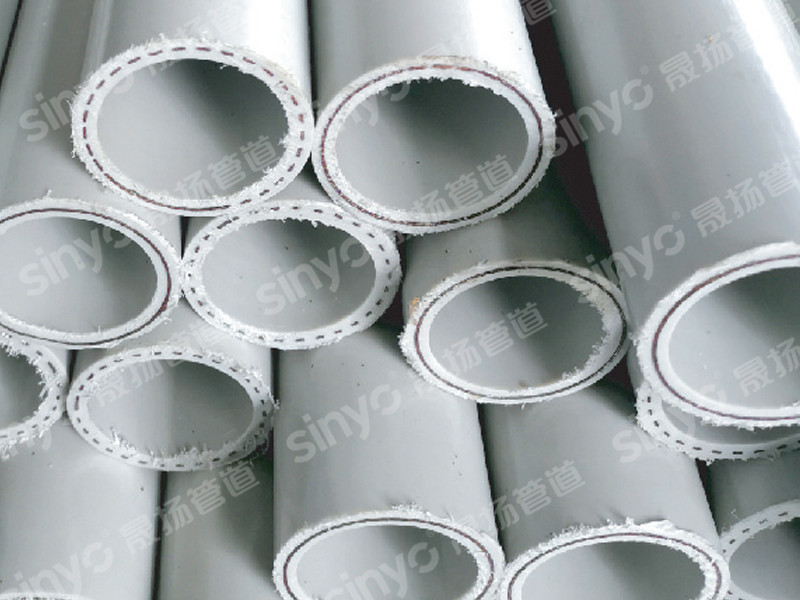
Kongwang steel strip polyethylene composite pipe
Kongwang perforated steel belt polyethylene composite pipe is a composite pipe material with a perforated steel pipe welded from cold-rolled steel strip as the reinforcing skeleton and composite thermoplastic plastic. Due to the introduction of the reinforcing skeleton, the pressure resistance of the pipe is significantly improved. Different types and grades of thermoplastic plastics can be used to produce composite pipe materials for different purposes. The perforated steel belt plastic pipes produced by the company are divided into several uses according to their uses: water supply, underground gas, hot water, chemical, and special uses.
Development prospects of large-diameter (large-caliber) pressure pipes
The application of plastic pipes, both domestically and internationally, started with smaller diameters and gradually developed towards larger diameters. (There is no defined definition for large diameter; in this article, large diameter refers to diameters of 800mm and above.) It is worth noting that in recent years, there has been a major international trend towards the development of large-diameter plastic pipes, driven by environmental protection. As is well known, the world is currently facing a battle against climate change, and all countries must bear the responsibility of reducing carbon emissions. In the pipeline industry, there is undoubtedly a need to pay more attention to environmental impact.
Contact Information
Fuqing Yuanhong Investment Zone, Fujian Province
Online Message
Welcome to leave a message online, we will promptly respond and provide you with a suitable solution.