The company mainly produces a series of new plastic pipe products, including PE/PP/PVC water supply, drainage, gas, mining, chemical, municipal, and power.


Design and application of PP-R pipes
1. Preface: Today, new types of water supply pipes are constantly being added to the construction market. PP-R pipe is one of them. PP-R pipe is a new type of pipe material that began to be produced and applied in China in recent years. There is no formal national standard for this product yet. Based on my practical application experience and the collected relevant information, the following text is compiled for reference by designers and relevant technical personnel.
Apr 29,2011
I. Preface:
New types of water supply pipes are constantly being introduced to the construction market. PP-R pipe is one of them. PP-R pipes are a new type of pipe material that began to be produced and applied in China in recent years. Formal national standards for this product have not yet been established. Based on practical application experience and collected information, the following text is compiled for reference by designers and relevant technical personnel.
II. Advantages and Disadvantages of PP-R Pipes:
PP-R pipes are a new type of energy-saving plastic product with international standards of the 1990s. The full name is random copolymer polypropylene pipe. The advantages and disadvantages of installation and use are as follows:
A. Advantages:
1. Harmless to human health, it does not react chemically with any ions in the water or chemicals in the building. Compared with metal pipes, it will not rust or corrode, and has high acid resistance and chloride resistance.
2. It is a green and sustainable product, causing no pollution to the environment during production, construction, and use. It can be recycled and reused.
3. Unlike other pipes, the homogeneous hot-melt connection of PP-R pipes is the biggest advantage of this pipe system. The leakage rate of pipe connections is extremely low, requiring no maintenance, and can be visually inspected. The joints are strong and completely corrosion-free.
4. Lightweight, easy to handle during construction, greatly reducing the labor intensity of workers and speeding up construction progress.
5. Good heat resistance: The instantaneous water temperature can reach 95 degrees. Long-term use at a working pressure not exceeding 0.6Mpa, the water temperature can reach 70 degrees. It can meet the needs of general domestic and industrial hot water, and is an ideal hot water pipe material.
6. Low thermal conductivity: The thermal conductivity at 20 degrees is 0.23~0.24W/Mk, which is much smaller than that of steel pipes and copper pipes. When used for hot water or air conditioning water supply and drainage, it can save investment in pipe insulation.
7. Relatively small elastic modulus: The stress generated by temperature changes is also smaller, suitable for direct burial methods embedded in walls and floor surfaces. It is beautiful, high-grade, and a current trend.
8. Low pipe resistance: The inner wall of the pipe is smooth, does not scale, and has low head loss. The head loss along the length is smaller than that of metal pipes, and the local head loss is also smaller than that of metal pipes.
9. Pipe repairability: The advantages of PP-R pipe hot-melt are fully demonstrated. Using a PP-R patching rod to repair pipes with pinholes, or cutting off damaged pipes and replacing them with new ones.
B. Disadvantages:
1. Higher cost: With continuous promotion, the price of pipe materials is now acceptable, but the price of pipe fittings is still too high. One reason is that the molds are imported; the other is that the copper and stainless steel fittings used in pipe fittings are specially made, requiring the temperature coefficient of expansion of these metal fittings to strictly match the temperature coefficient of expansion of the PP-R material, which also needs to be imported from abroad.
2. Few pipe specifications, only products with outer diameters of 20 to 110 millimeters; insufficient types of fittings and valves, and problems with inconvenient connection to metal valves.
3. Rigidity and impact resistance are inferior to metal pipes.
4. The coefficient of linear expansion is relatively large, and more pipe supports are required for exposed or overhead laying, affecting the appearance.
5. Advanced and complex construction equipment, high construction process requirements, and high requirements for the quality of construction personnel and construction management. The quality of the hot-melt joint is related to the temperature, heating time, and joint pressure, and deviations are more likely to occur during construction.
6. Poor UV resistance, easy to age under long-term sunlight exposure.
7. PP-R pipes are combustible materials and therefore cannot be used in fire water supply systems.
III. Design and Application of PP-R Pipes
1. Pipe selection is based on the following principles:
a. The specifications and wall thickness of the pipe are corresponding. The thicker the pipe wall, the higher the pressure resistance, the higher the grade, and the higher the price.
b. For hot water systems, the higher the water temperature, the thicker the pipe wall required. Considering the safety of hot water systems, generally hot water pipes must choose pipes with a grade no less than PN2.0Mpa.
c. Select different pipe grades based on water supply safety and economy. The higher the grade of the pipe for important applications.
2. Pipe laying methods:
a. The laying method of PP-R pipes is basically the same as that of traditional metal pipes, and the pipes can be arranged using a series (main pipe branch) method. This laying method can save a large amount of materials compared with flexible plastic pipes (such as PEX, PE-AL-PE), which is economical and reasonable and more in line with China's national conditions.
b. According to the direction of pipe laying, it can be divided into exposed and concealed laying. Concealed laying is divided into direct burial and non-direct burial. Direct burial methods include: embedding in walls and laying in floor surfaces; non-direct burial methods include: pipe wells, ceilings, behind decorative panels, and overhead layers in the floor.
c. PP-R pipes are most suitable for concealed laying. Concealed laying should be coordinated with building and structural professionals, and appropriate protective measures should be taken. Pressure testing must be carried out after the pipe laying is completed. Only after passing the inspection can the pipes be buried, and the location of the pipes should be clearly marked on the wall or ground. A second pressure test should be carried out after the civil engineering and secondary decoration are completed to eliminate the possibility of PP-R pipes being damaged. Only after passing the inspection can they be officially put into use. This secondary pressure test method is also applicable to other concealed pipes. I suggest that this acceptance method be included in the relevant specifications.
3. Pipe connection methods:
a. PP-R pipe connection methods include: hot melt connection, electrofusion connection, threaded connection, flange connection, etc. Appropriate methods should be selected according to different construction sites and requirements.
b. Hot melt connection and electrofusion connection are suitable for connecting PP-R pipes and fittings. Direct burial must use hot melt or electrofusion connection. Electrofusion connection has a higher construction cost and is suitable for the final connection of pipes or occasions where it is inconvenient to use construction tools.
c. Threaded connections and flange connections are used to connect PP-R pipes with metal pipes or metal water appliances. Generally, threaded connections are suitable for small-diameter pipes; flange connections are suitable for large-diameter pipes. Threaded connections or flange connections with live joints are used in situations where pipes are frequently disassembled and reassembled.
4. Construction tools:
Construction tools: The construction tools for PP-R pipes include handheld hot melt welders, trolley-type hot melt welders, electric hot melt voltage controllers, and matching heating heads, scissors, cutting knives, brackets, etc. Handheld hot melt welders are smaller and more flexible, suitable for hot melt welding of medium and small diameter PP-R pipes. Trolley-type hot melt welders have a certain volume and weight, suitable for pre-assembly of hot melt welding of large and medium diameter PP-R pipes, that is, PP-R pipes and fittings are pre-assembled on the ground according to the drawing requirements, and then the pre-assembled pipes are assembled at the pipe laying location. The heating power of the hot melt tools is generally 700-1500W, among which 700-800W tools are suitable for hot melting of PP-R pipes with specifications of Ф63mm and below; 1200-1500W tools are suitable for hot melting of pipe materials with specifications of Ф75mm and above. The hot melt tool consists of a heating plate (with temperature control device) and a heating head, and the corresponding heating head can be replaced for different specifications of pipe materials. The heating temperature of the hot melt welder is automatically controlled, generally at 260±10 degrees. Electric hot melt PP-R fittings embed resistance wires on the socket surface of the fittings. During construction, the surface of the pipe is peeled to a suitable matching size and inserted into the electric hot melt socket. Then, the current is passed through the connecting plug of the fitting. Under the specified voltage and time, the resistance wire generates heat to melt and weld the pipe and fitting. The function of the electric hot melt voltage controller is to convert the 220V voltage into a 39.5V low voltage, and energize it according to the preset time. The controller has a microcomputer, which can identify the ambient temperature and automatically adjust the heating parameters to ensure the welding quality in different operating environments.
5. Support brackets for PP-R pipelines:
a. For the aesthetic requirements of exposed pipeline networks, it is necessary to use dense fixed pipe clamps to restrain pipe deformation. This can avoid the unsightly "snake-like deformation" and collapse problems commonly seen in plastic pipe network systems.
b. Pipe support spacing (mm):
Temperature difference Pipe diameter (mm)
20 25 32 40 50 63 75 90 110
20 600 750 900 1000 1200 1400 1500 1600 1800
30 600 750 900 1000 1200 1400 1500 1600 1800
40 600 700 800 900 1100 1300 1400 1500 1700
50 600 700 800 900 1100 1300 1400 1500 1700
60 550 650 750 850 1000 1150 1250 1400 1600
70 550 600 700 800 950 1050 1150 1250 1400
6. Repair of PP-R pipelines:
a. If the pipeline is damaged, and there are pinholes in the buried pipeline, a 7mm or 12mm repair heating head and a PP-R patching rod can be used for repair. If this function can be extended to planting small pipes on large pipes, it can greatly reduce the number of three-way fittings and reduce the cost.
b. The damaged section of the damaged pipeline can also be cut off and replaced with a new section of pipeline using ordinary hot welding.
IV. Problems encountered in the practical application of PP-R pipelines:
1. Some brands of PP-R pipe fittings are not complete, and installation and use are inconvenient. For example, there are no 50×20 and 63×20 three-way fittings. The manufacturer explained that the diameter difference of the three-way fittings is only one or two levels, and the manufacturing standard of the three-way fittings is a foreign standard, which is different from the domestic usage. For example, for a 63mm pipe leading out a 20mm branch pipe, a 63×50 three-way fitting and several reducing connectors are needed to reach a 20mm branch pipe, which is expensive and unaesthetic. If the pipe repair technology can be used to plant small pipes on large pipes, it would be ideal to solve the problem of three-way fittings.
2. There are also some problems with the flange connection of PP-R pipes and ordinary metal fittings: For example, there are problems with the pressure reducing valve group set on the PP-R pipe using ordinary flange connection, the flange of the pressure reducing valve group and the flange on the PP-R pipe do not match, because the outer diameter of the metal fitting and the PP-R pipe with the same inner diameter is different (different wall thickness), that is, the flange of the PP-R pipe is one size larger than the flange of the metal fitting. The on-site construction unit cannot solve it, so they ask the PP-R pipe manufacturer to solve it, and the manufacturer specially customized some flanges to solve this problem.
Previous:
Related News
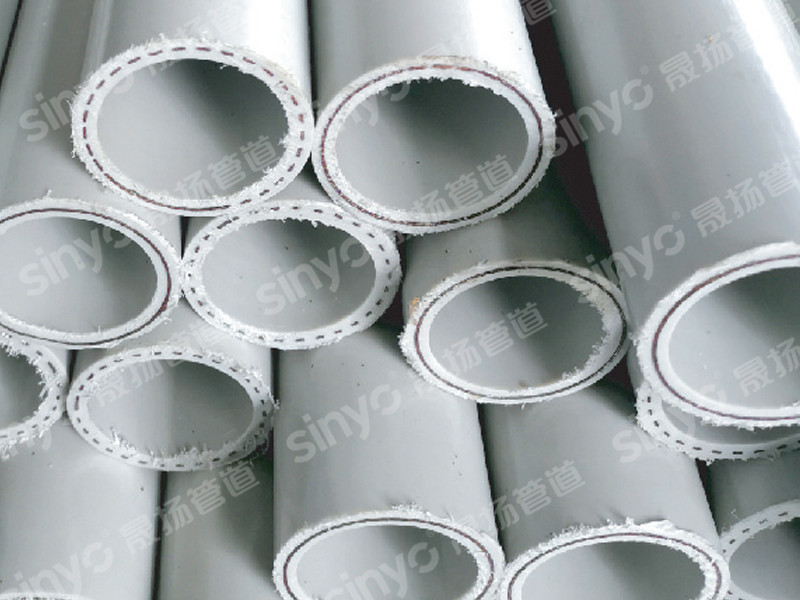
Kongwang steel strip polyethylene composite pipe
Kongwang perforated steel belt polyethylene composite pipe is a composite pipe material with a perforated steel pipe welded from cold-rolled steel strip as the reinforcing skeleton and composite thermoplastic plastic. Due to the introduction of the reinforcing skeleton, the pressure resistance of the pipe is significantly improved. Different types and grades of thermoplastic plastics can be used to produce composite pipe materials for different purposes. The perforated steel belt plastic pipes produced by the company are divided into several uses according to their uses: water supply, underground gas, hot water, chemical, and special uses.
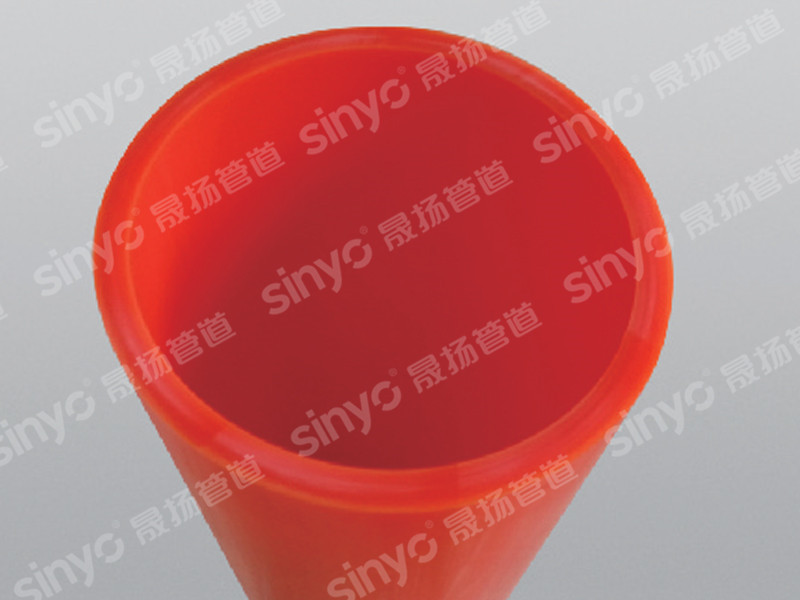
Development prospects of large-diameter (large-caliber) pressure pipes
The application of plastic pipes, both domestically and internationally, started with smaller diameters and gradually developed towards larger diameters. (There is no defined definition for large diameter; in this article, large diameter refers to diameters of 800mm and above.) It is worth noting that in recent years, there has been a major international trend towards the development of large-diameter plastic pipes, driven by environmental protection. As is well known, the world is currently facing a battle against climate change, and all countries must bear the responsibility of reducing carbon emissions. In the pipeline industry, there is undoubtedly a need to pay more attention to environmental impact.
Contact Information
Fuqing Yuanhong Investment Zone, Fujian Province
Online Message
Welcome to leave a message online, we will promptly respond and provide you with a suitable solution.