The company mainly produces a series of new plastic pipe products, including PE/PP/PVC water supply, drainage, gas, mining, chemical, municipal, and power.


In 2015, the central government issued No. 1 document
No. 1 Central Document of 2015, "Several Opinions on Increasing Reform and Innovation and Accelerating the Construction of Modern Agriculture", was officially released on February 1, setting the overall tone for China's agricultural and rural work in 2015 and beyond. This marks the 12th consecutive year since 2004 that the No. 1 Central Document has focused on agriculture, rural areas, and farmers.
Mar 04,2015
The No. 1 Central Document of 2015, "Several Opinions on Increasing the Strength of Reform and Innovation and Accelerating the Construction of Modern Agriculture," was officially released on February 1, setting the overall tone for China's agricultural and rural work in 2015 and beyond. This marks the 12th consecutive year, since 2004, that the No. 1 Central Document has focused on "agriculture, rural areas, and farmers."
The 2015 No. 1 Document covers five major aspects: 1. Building modern agriculture and accelerating the transformation of agricultural development; 2. Increasing farmers' income and increasing the strength of preferential agricultural policies; 3. Promoting integrated urban-rural development and advancing new rural construction; 4. Enhancing rural development vitality and comprehensively deepening rural reforms; 5. Strengthening rural legal construction and improving "agriculture, rural areas, and farmers" work.
The document proposes that we must always adhere to solving the problems of "agriculture, rural areas, and farmers" as the top priority of the Party's work, relying on reform to increase momentum and using the rule of law as a guarantee to accelerate the advancement of Chinese-style agricultural modernization.
Regarding water conservancy-related work, the No. 1 Document proposes focusing on building modern agriculture and accelerating the transformation of agricultural development.
We need to innovate investment and financing mechanisms, increase capital investment, and concentrate efforts to accelerate the construction of a number of major water diversion projects, key water source projects, and key projects for the governance of rivers, lakes, and seas. Land compensation and the balance of cultivated land occupation and compensation for major water conservancy projects will be implemented with the same policies as those for major national infrastructure projects such as railways.
We need to accelerate the follow-up construction and water-saving transformation of large and medium-sized irrigation districts, accelerate the construction of modern irrigation districts, and strengthen the construction of small-scale farmland water conservancy infrastructure.
We need to vigorously promote water-saving technologies and comprehensively implement regional-scale, high-efficiency water-saving irrigation actions. We need to increase efforts in water pollution control and water ecological protection.
It is planned to implement a new round of returning farmland to forests and grasslands, expand the scope of remediation of heavy metal-contaminated farmland, comprehensive management of groundwater overdraft areas, and pilot projects for returning farmland to wetlands, and promote the construction of key water and soil conservation projects such as ecologically clean small watersheds in important water source areas.
We need to implement wetland ecological benefit compensation, pilot programs for wetland protection rewards, and subsidy policies for desertified land closure and protection areas.
We need to establish and improve the responsibility system for agricultural ecological environmental protection, strengthen accountability and supervision, and severely investigate and punish various acts that damage the ecological environment in accordance with the law and regulations.
In terms of promoting farmers' income and increasing the strength of preferential agricultural policies, we need to expand the scope of subsidies for the purchase of water-saving irrigation equipment.
We need to focus on integrated urban-rural development and advance new rural construction. The document proposes increasing the strength of rural infrastructure construction. We need to ensure the timely completion of the "Twelfth Five-Year Plan" rural drinking water safety project, promote the improvement and efficiency of rural drinking water, and continue to implement preferential tax policies.
We need to promote the extension of urban water supply networks to rural areas. We need to adopt power grid extensions and power supply methods such as photovoltaic, wind power, and small hydropower, according to local conditions, to solve the electricity problem for people without electricity in 2015.
We need to comprehensively promote the improvement of the rural living environment. We will continue to support the concentrated and contiguous improvement of the rural environment, accelerate the comprehensive improvement of rural rivers and ponds, carry out special improvement of rural garbage, and increase efforts in rural sewage treatment and toilet renovation.
We need to guide and encourage social capital to invest in rural construction. We need to encourage social capital to invest in rural infrastructure construction and the establishment of various undertakings in rural areas. For government-led, government-supported rural public welfare projects, we can adopt methods such as purchasing services and government-private partnerships to guide enterprises and social organizations to participate in construction, maintenance, and operation. The Agricultural Development Bank should increase the loan strength for water conservancy, poverty-stricken area highways, and other agricultural and rural infrastructure construction while strengthening its policy-oriented functions.
Related News
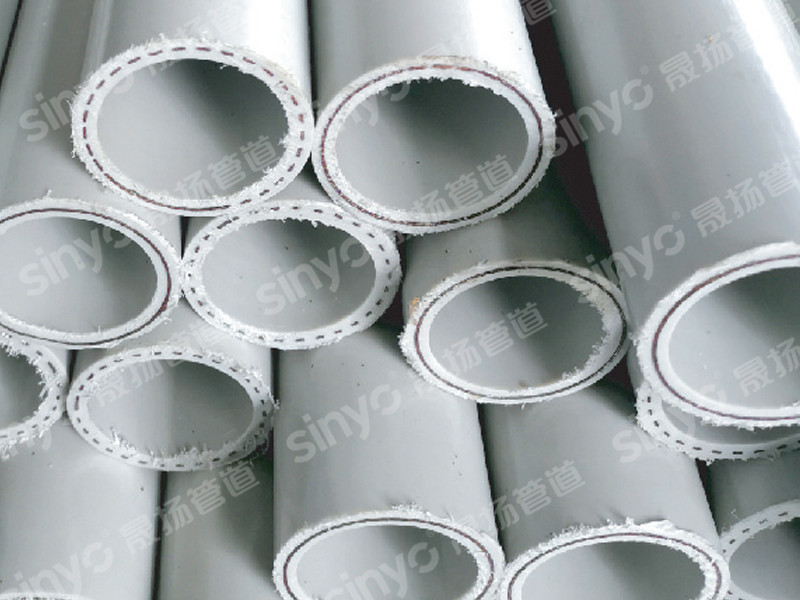
Kongwang steel strip polyethylene composite pipe
Kongwang perforated steel belt polyethylene composite pipe is a composite pipe material with a perforated steel pipe welded from cold-rolled steel strip as the reinforcing skeleton and composite thermoplastic plastic. Due to the introduction of the reinforcing skeleton, the pressure resistance of the pipe is significantly improved. Different types and grades of thermoplastic plastics can be used to produce composite pipe materials for different purposes. The perforated steel belt plastic pipes produced by the company are divided into several uses according to their uses: water supply, underground gas, hot water, chemical, and special uses.

Development prospects of large-diameter (large-caliber) pressure pipes
The application of plastic pipes, both domestically and internationally, started with smaller diameters and gradually developed towards larger diameters. (There is no defined definition for large diameter; in this article, large diameter refers to diameters of 800mm and above.) It is worth noting that in recent years, there has been a major international trend towards the development of large-diameter plastic pipes, driven by environmental protection. As is well known, the world is currently facing a battle against climate change, and all countries must bear the responsibility of reducing carbon emissions. In the pipeline industry, there is undoubtedly a need to pay more attention to environmental impact.
Contact Information
Fuqing Yuanhong Investment Zone, Fujian Province
Online Message
Welcome to leave a message online, we will promptly respond and provide you with a suitable solution.